The $14,200 Benchmark: 5 Strategic Marketing Truths for the 2025 Real Estate Market


1. Introduction: The High Cost of Staying Invisible
In the current real estate landscape, we are witnessing a tale of two industries. On one side, the median NAR member reports a gross income of just $58,100—a figure pressured by a market where, in many regions, there are now more licensed Realtors than homes sold annually. On the other side, a cohort of elite performers is scaling through the noise.
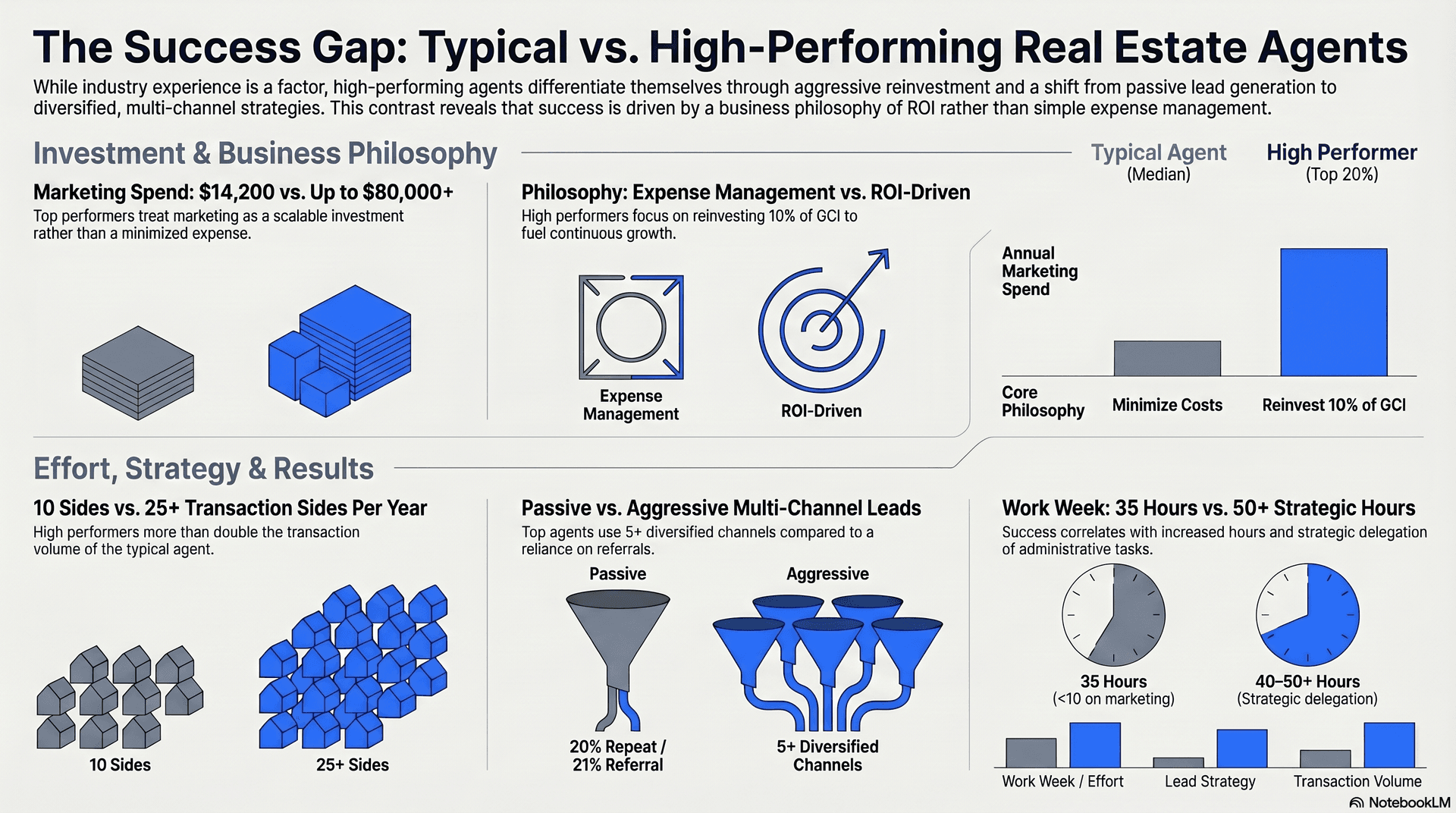
The "entry fee" for visibility is rising; the average marketing spend climbed to $14,200 in 2024. However, as a growth strategist, I see that most agents are simply throwing money at "scroll-past" noise. To thrive in 2025, you must move from expense management to an ROI-driven reinvestment strategy. Staying invisible isn't just a missed opportunity; it is a terminal business risk.
2. The "Multi-Channel" Premium: Why Five is the Magic Number

If you are relying solely on Zillow leads or Facebook organic reach, you are exposed to significant platform risk. High-performing agents view diversification as a hedge against shifting algorithms. The data is definitive: agents utilizing five or more marketing channels reported an average Gross Commission Income (GCI) of $4 million.
Compare that $4 million GCI to the $58,100 industry median. The "diversification premium" isn't just about more leads—it’s about creating an omnichannel "trust ecosystem." When a prospect sees your brand on a yard sign, then a Facebook ad, and later on their streaming TV, you cease being a commodity and start being an authority.
"The diversification premium suggests that limiting marketing to a single channel, even a high-performing one, leaves opportunity on the table."
3. The Video Paradox: 403% More Inquiries, Yet Still Underutilized
Video is the ultimate high-leverage asset, yet it remains the most neglected tool in the average agent's kit. Listings with video receive 403% more inquiries than those without, and 73% of homeowners are more likely to list with a video-forward agent. Despite these numbers, many agents still hide behind static headshots.
In a relationship-driven business, video acts as your "digital twin," scaling your personality 24/7. It reduces your Customer Acquisition Cost (CAC) by building rapport before the first phone call even occurs.
Video Impact Metrics:
Listing Gravity: 403% increase in inquiries for listings featuring video.
Retention Power: 87% more views for properties featuring 3D virtual tours.
Revenue Velocity: Video-forward realtors grow revenue 49% faster than their peers.Sales Speed: Drone-assisted listings sell 68% faster than traditional listings.
Viral Coefficient: Video content generates 1,200% more shares than text and image posts combined.
4. The Democratization of the "Big Screen" (Streaming TV)
For decades, television was the exclusive playground of national brokerages with six-figure budgets. Today, streaming TV (Connected TV) has lower barriers to entry than many direct mail campaigns. With budgets as low as $50 to $500 per month and average CPMs (cost per thousand impressions) around $25, the "Big Screen" is officially democratized.
Appearing on a household television via Hulu or Roku is a powerful differentiation opportunity. While social media is a "lean-forward" high-distraction environment where users are trained to scroll past ads, streaming TV is "lean-back" content. It provides the pre-emptive authority required to win the listing before the homeowner even begins their search.
Action Box: Strategic Geographic Targeting To dominate your local "farm" area, target a tight 10-20 mile radius around your core market. A modest $500/month investment on streaming platforms can deliver approximately 20,000 local impressions. This creates a "local celebrity" effect that makes your digital and physical marketing significantly more effective.
5. The "First Contact" Rule: Why You Only Get One Shot
In real estate marketing, the "Top-of-Funnel" is the only funnel that matters. Data shows that 71% of buyers and a staggering 81% of sellers only contact one agent. This is why marketing must be a pre-emptive strike. If you aren't the obvious choice before the prospect realizes they need an agent, you’ve already lost the transaction to whoever was top-of-mind.
Brand recognition must precede the search. By the time a seller looks for an agent, they aren't "shopping"—they are confirming a decision they’ve likely already made based on who they perceive as the dominant local expert.
"71% of buyers say they're more likely to work with agents who have a strong presence across channels."
6. The DIY Trap: Efficiency vs. Effectiveness
The "DIY Trap" is where growth goes to die. Currently, 57% of agents handle all marketing themselves, but 85% of those spend less than 10 hours a week on it. This low-effort approach is why the median agent closes only 10 sides a year.
Top producers treat marketing as a scalable engine. While the median agent views $14,200 as a cost to be minimized, the top 20% of producers are aggressively reinvesting, often spending upwards of $80,000 annually to maintain their $4M+ GCI status.
7. Conclusion: The 2025 Playbook
As we head into 2025, the "digital front door" is the only door. With 96% of buyers starting their journey online, your digital presence is no longer a supplement to your business—it is your business. In a market defined by extreme competition and tightening inventory, the winners will be those who move away from "aimless" marketing and lean into high-authority, multi-channel strategies.
Final Thought: In a market where 81% of sellers only interview one person, are you doing enough to ensure that person is you before the search even begins?